Institute of Physics · Academia Sinica · Taipei

Hello, I am Satyajit Puhan

Postdoctoral Researcher — hadron structure & light-front QCD

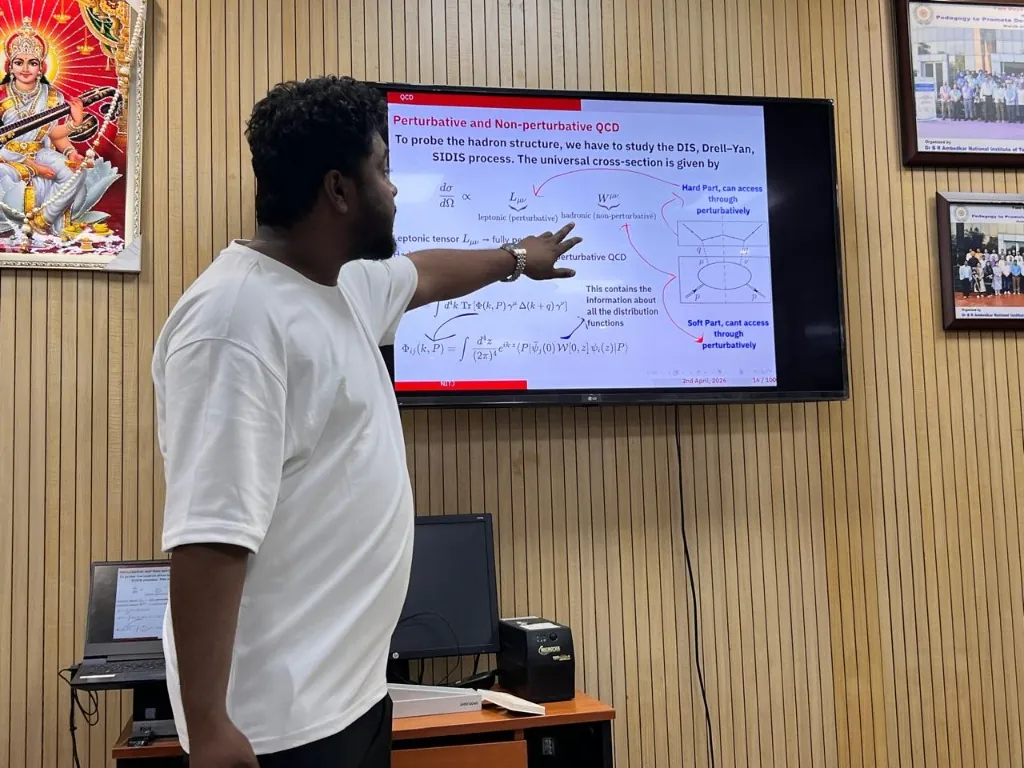
I map the inside of hadrons — pions, kaons, ρ mesons and quarkonia — using transverse-momentum-dependent and generalized parton distributions, form factors and light-front dynamics. PhD defended at NIT Jalandhar on 2 April 2026; now continuing that work at Academia Sinica.

44
Publications
231
Citations
10
h-index
Citations per year
  1. 2 2023
  2. 44 2024
  3. 84 2025
  4. 101 2026so far

Synced daily from INSPIRE-HEP · 2026-11-04

Published inPhys. Rev. D×9PTEP×3Chin. Phys. CEur. Phys. J. AEur. Phys. J. PlusJHEPNucl. Phys. ANucl. Phys. BPhys. Lett. B

Veni, vidi, vici

I came · I saw · I conquered

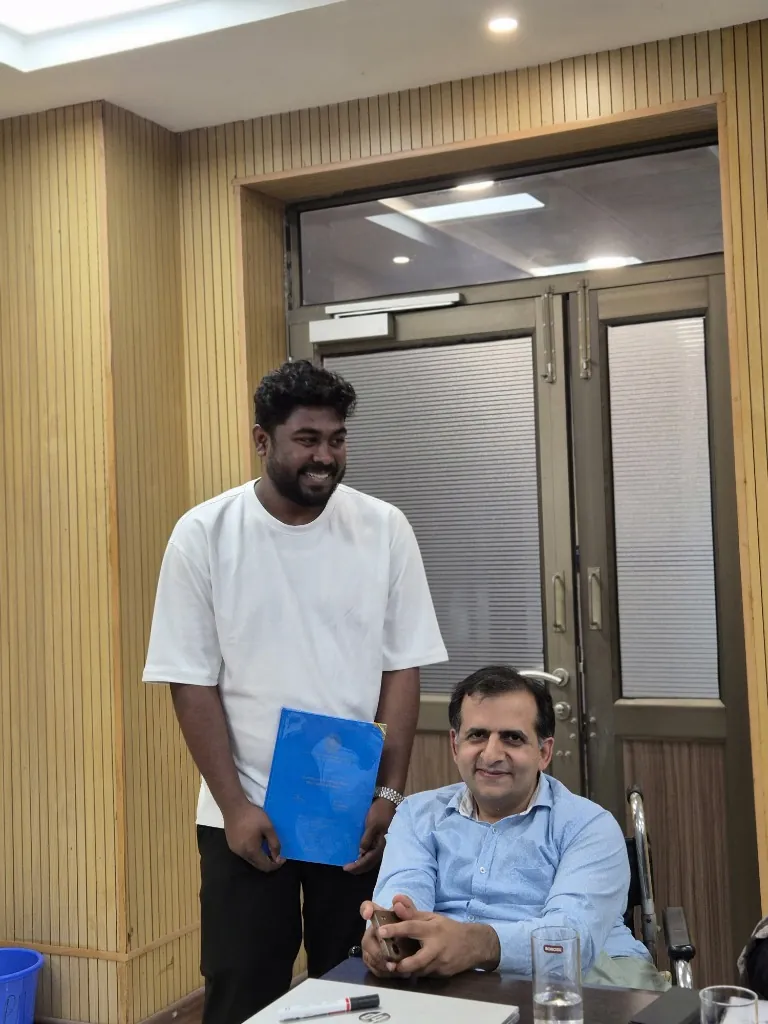
Satyajit Puhan at his desk, in front of a whiteboard of equations
Open to collaborations

Latest

Recent News & Activities

Highlights from my research journey.

📄 New preprint! 2026-09-30

Diffractive Vector-Meson Production from the Light-Front Quark Model

We study exclusive diffractive electroproduction of the ρ^0, ϕ, J/ψ, and ψ(2S) mesons in the color-dipole picture using two spin-orbit light-front wave functions, S-1 and S-2.

Details

📄 New preprint!

Title: Diffractive Vector-Meson Production from the Light-Front Quark Model Authors: S. Puhan Published in: e-Print: 2609.39647 [hep-ph] e-Print: 2609.39647 [hep-ph] INSPIRE-HEP: record 3209881

Abstract

We study exclusive diffractive electroproduction of the ρ^0, ϕ, J/ψ, and ψ(2S) mesons in the color-dipole picture using two spin-orbit light-front wave functions, S-1 and S-2. S-1 follows from the Melosh--Wigner rotation in the light-front quark model (LFQM), while S-2 is the spin-improved form commonly used in holographic and boosted-Gaussian approaches. Both share the same radial wave function, with their parameters determined from the LFQM Hamiltonian. The color-glass-condensate dipole parameters are fixed from inclusive structure-function data, with no fit to diffractive data. We compare the predictions with measurements of cross sections, R=σ_L/σ_T, t and W dependences, and σ_ϕ/σ_ρ. S-1 gives a better description of the light-meson observables, while S-2 provides a better description of the charmonium ratio σ_ψ(2S)/σ_J/ψ and the J/ψ decay constant. We also present the charge, magnetic, and quadrupole form factors of the four mesons and compare them with available lattice-QCD results


Added automatically from INSPIRE-HEP

📄 New preprint! 2026-09-03

Leading-Neutron Electroproduction at HERA and the EIC: Sullivan Process, Target Fragmentation, and Pion PDFs

Leading-neutron electroproduction measurements from the H1 and ZEUS experiments at HERA have been used to constrain pion parton distribution functions (PDFs) at small momentum…

Details

📄 New preprint!

Title: Leading-Neutron Electroproduction at HERA and the EIC: Sullivan Process, Target Fragmentation, and Pion PDFs Authors: W. Chang, C. Hsieh, S. Puhan Published in: e-Print: 2609.03368 [hep-ph] e-Print: 2609.03368 [hep-ph] INSPIRE-HEP: record 3199506

Abstract

Leading-neutron electroproduction measurements from the H1 and ZEUS experiments at HERA have been used to constrain pion parton distribution functions (PDFs) at small momentum fractions within the Sullivan one-pion-exchange (OPE) framework, complementing large-x_π constraints from pion-induced Drell--Yan measurements. Previous analyses have focused primarily on the region of large neutron longitudinal momentum fraction, x_L, where contributions from deep-inelastic scattering (DIS) target fragmentation are suppressed. In this work, we use the Pythia event generator to model the target-fragmentation contribution and show that its combination with the OPE contribution reproduces the main features of the HERA leading-neutron data over the full measured x_L range without introducing additional ad hoc normalization factors. This result demonstrates the potential of incorporating a broader range of leading-neutron data into future global analyses, thereby extending sensitivity to smaller pion momentum fractions x_π. We investigate the model dependence associated with the pion--nucleon vertex form factor and show that the HERA data are sensitive to different target-fragmentation treatments implemented in Pythia. Finally, we present projections for leading-neutron production at the future U.S. Electron-Ion Collider (EIC), identifying beam-energy configurations and kinematic regions that provide enhanced sensitivity to pion structure while suppressing DIS target-fragmentation contributions


Added automatically from INSPIRE-HEP

📄 New preprint! 2026-08-07

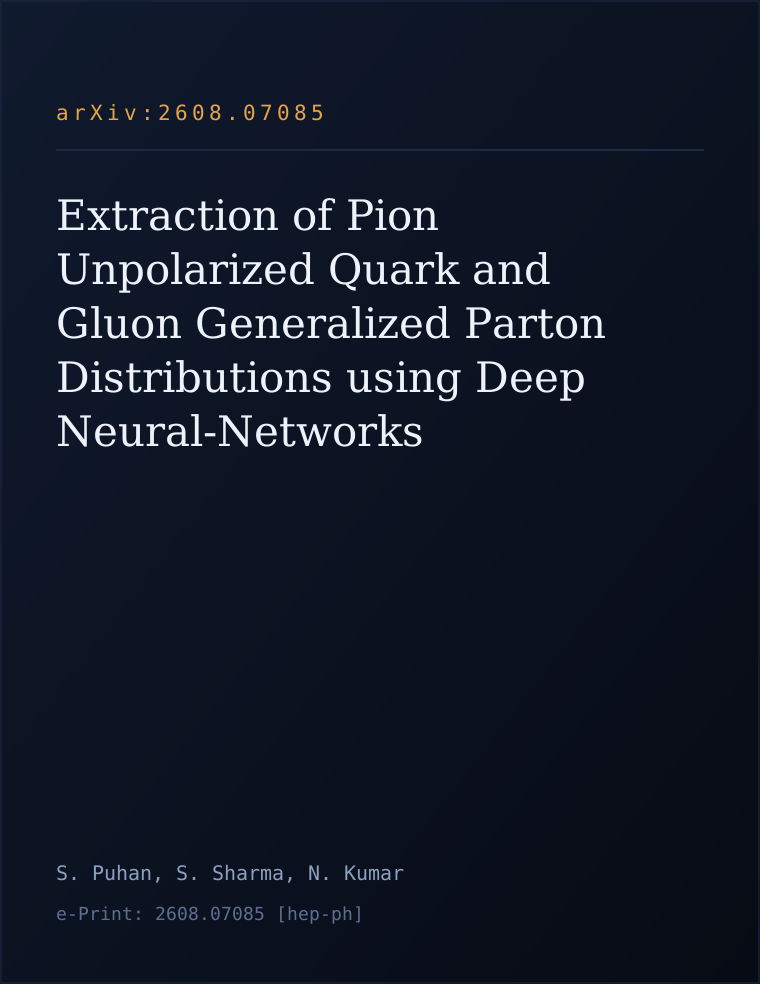
Extraction of Pion Unpolarized Quark and Gluon Generalized Parton Distributions using Deep Neural-Networks

We present a deep neural-network (DNN) extraction of the pion unpolarized quark and gluon generalized parton distributions (GPDs) using the corresponding parton distribution f…

Details

📄 New preprint!

Title: Extraction of Pion Unpolarized Quark and Gluon Generalized Parton Distributions using Deep Neural-Networks Authors: S. Puhan, S. Sharma, N. Kumar Published in: e-Print: 2608.07085 [hep-ph] e-Print: 2608.07085 [hep-ph] INSPIRE-HEP: record 3188657

Abstract

We present a deep neural-network (DNN) extraction of the pion unpolarized quark and gluon generalized parton distributions (GPDs) using the corresponding parton distribution functions (PDFs) from the JAM21 and xFitter analysis, together with experimental measurements of the pion electromagnetic form factor (EMFF) and lattice quantum chromodynamics (QCD) results. The GPDs are parameterized using a physics-informed neural-network (PINN) that incorporates the known PDF behavior, an exponential momentum-transfer dependence, and a trainable neural network (NN) component. The network parameters are determined by minimizing a χ^2-based loss function. For the valence-quark GPDs, the loss function includes contributions from the EMFF, squared EMFF, charge-normalization constraints, and regularization terms. For the gluon GPDs, it incorporates constraints from the gluon gravitational form factors together with regularization. This framework enables a flexible, nonparametric extraction while preserving the essential theoretical and phenomenological constraints. By employing the full ensemble of available PDF replicas, we quantify the uncertainties of the extracted GPDs over a broad kinematic range in the longitudinal momentum fraction and momentum transfer, with the uncertainty bands corresponding to the 1σ confidence interval. The extracted valence-quark GPDs are found to be in good agreement with available lattice-QCD calculations. Our study demonstrates that DNN-based methods provide a flexible and robust framework for extracting pion GPDs and probing the multidimensional internal structure of the pion, offering a promising avenue for future investigations of hadron tomography


Added automatically from INSPIRE-HEP

All 21 updates

Satyajit Puhan

About me

From a village in Odisha to Academia Sinica

Born in Chhatara, a small village in Balasore, Odisha, to a family of farmers. Ranked AIR-877 in JAM and AIR-209 in JEST, took an M.Sc. at NIT Jamshedpur and a PhD at NIT Jalandhar under Dr. Harleen Dahiya, with a visiting fellowship at JINR Dubna. Now a postdoctoral researcher at the Institute of Physics, Academia Sinica, Taipei.

Read the full story

Moments from the journey

All 17 photos

What I do

Research Areas

I work out the three-dimensional, spin and mechanical structure of hadrons — from the pion to bottomonium — with light-front wave functions, and confront it with data and lattice QCD.

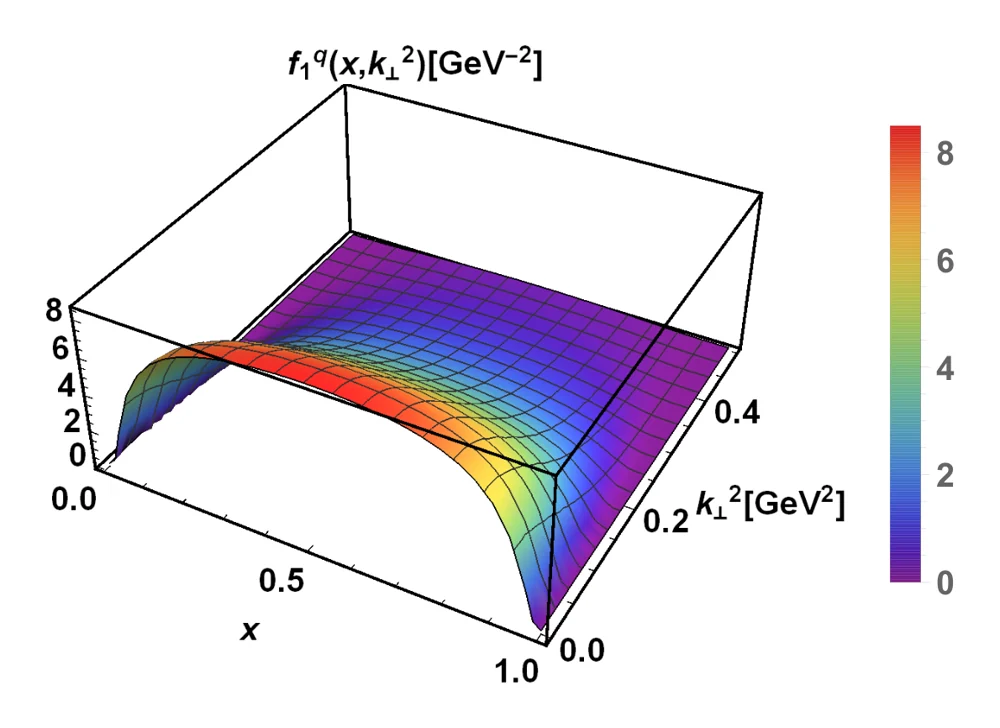
Unpolarized pion TMD f₁(x, k⊥²) in the light-cone quark model
1 / 6

3D imaging of light mesons

Momentum- and position-space tomography of the pion and kaon: all T-even TMDs up to twist-4, twelve non-zero GTMDs, GPDs and spin–orbit correlations from light-front wave functions.

TMDs to twist-4GTMDsGPDs
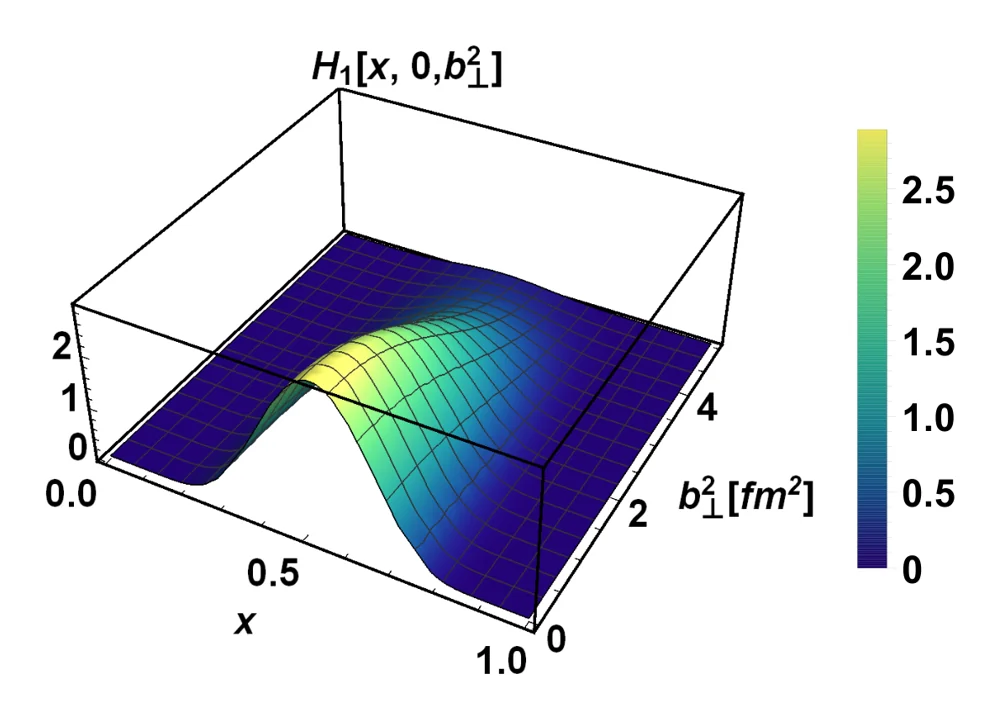
Impact-parameter GPD H₁(x, 0, b⊥²) of the J/ψ
2 / 6

Spin-1 hadrons and the photon

The richer structure of ρ, J/ψ and Υ and of the photon itself: TMDs, vector GPDs, charge-magnetic-quadrupole form factors and PDFs with two competing spin wave functions.

ρ, J/ψ, ΥTensor polarizationVector GPDs
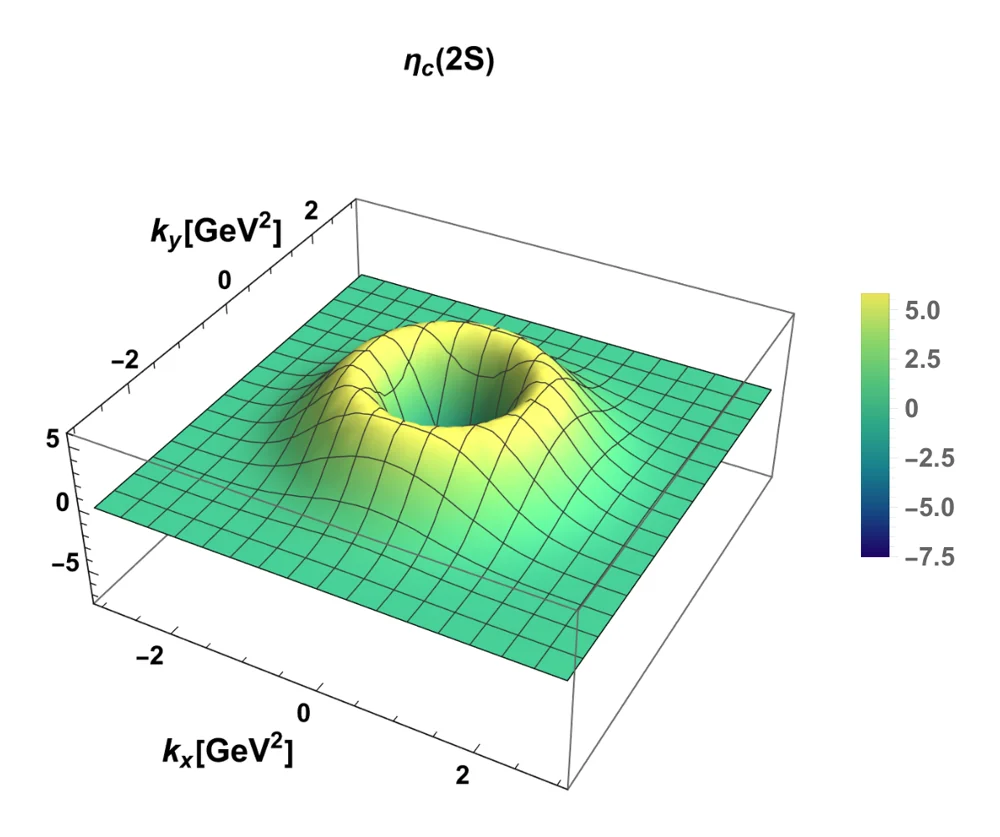
ηc(2S) light-front wave function, showing its radial node
3 / 6

Quarkonium and heavy mesons

Charmonium and bottomonium beyond the ground state — 2S, 3S and 1P spectra, decay constants, distribution amplitudes and E1 radiative transitions such as ψ(2S) → χc0 γ.

CharmoniumBottomoniumRadial excitations
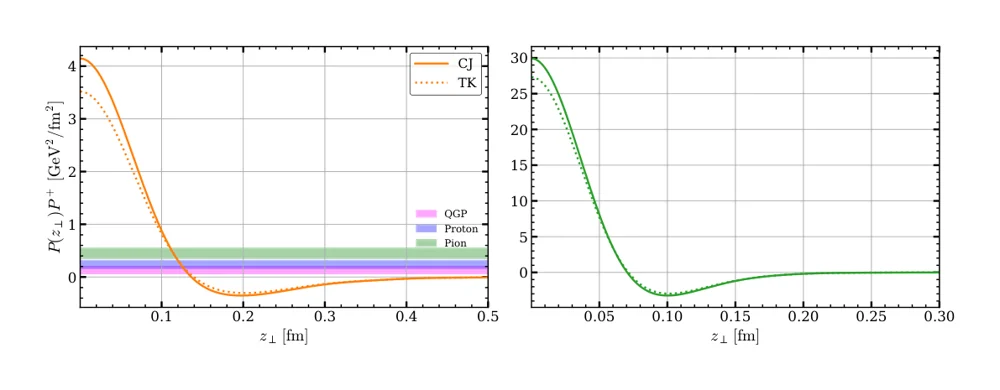
Pressure distribution inside ηc (left) and ηb (right)
4 / 6

Form factors and mechanical structure

What the energy-momentum tensor says about pressure and shear inside a hadron, and the full set of scalar, vector and tensor form factors of the pion and kaon.

Gravitational FFsD-termPressure & shear
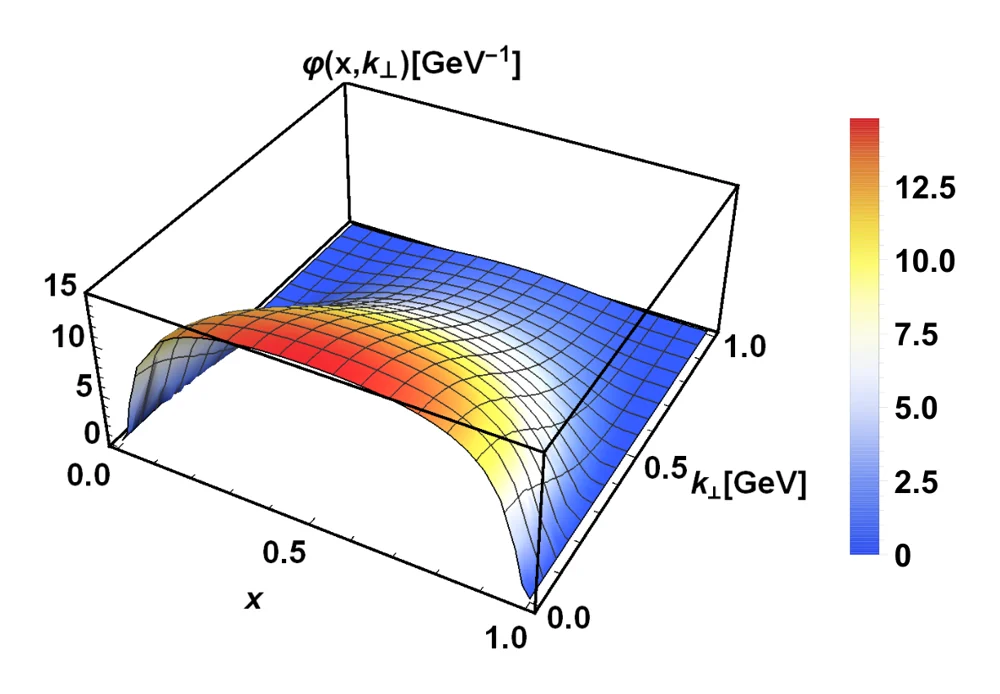
Pion light-cone wave function φ(x, k⊥) used as input for the medium study
5 / 6

Hadrons in nuclear matter

How dense, isospin-asymmetric and hot nuclear matter reshapes π, K, ρ, D and B mesons — quark masses from the chiral SU(3) quark mean-field model fed into light-front wave functions.

Chiral SU(3) quark mean fieldIsospin asymmetryFinite temperature
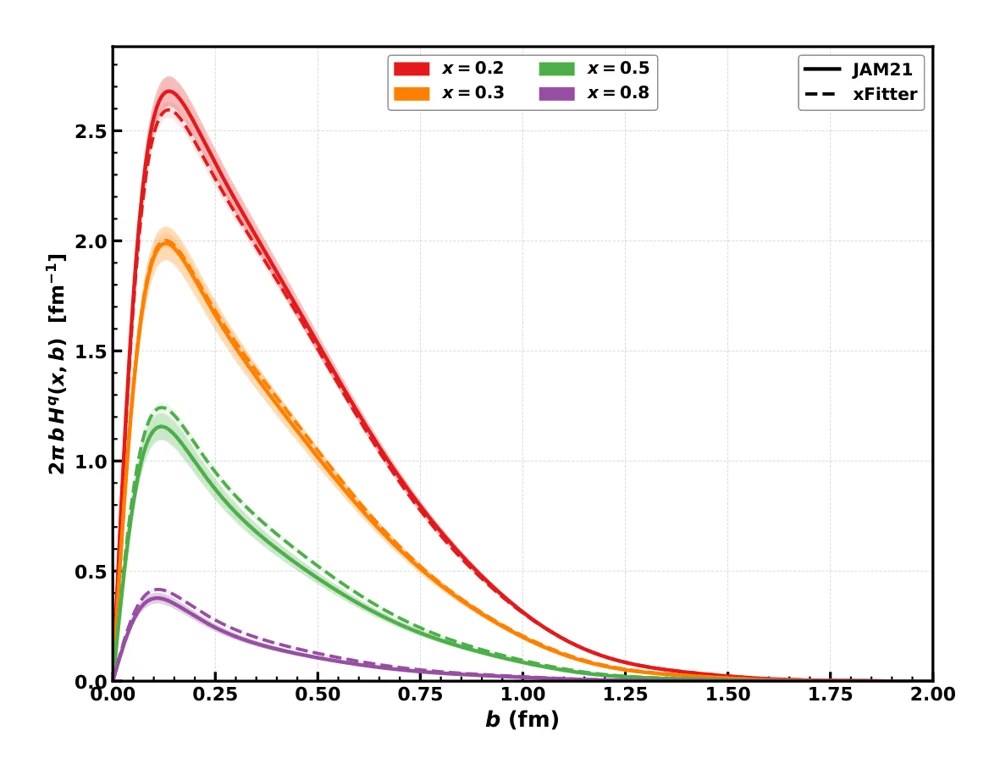
Pion quark density 2πb H^q(x, b) from the neural-network fit, with uncertainty bands
6 / 6

Data-driven extraction and collider phenomenology

Pion quark and gluon GPDs extracted with physics-informed neural networks, pion PDFs tested against data, and predictions for NICA-SPD, HERA and the EIC.

Neural-network GPDsPion PDFsNICA-SPD

More on the research

What comes next

Research outlook

Where the work is heading next — from the problems I am starting now to the hard, open questions I want to crack.

  1. Next · 2026–27

    Energy-momentum tensor of spin-1 mesons

    Difficulty 3 / 5

    The full set of gravitational form factors of the ρ meson and of heavy vector mesons (J/ψ, Υ) in the light-front quark model — including the D-term — and from them the pressure, shear-force and energy distributions, the mechanical radius and the quadrupole deformation of a spin-1 hadron.

    Why it is hard: A spin-1 hadron has six gravitational form factors instead of two, some only reachable from 'bad' current components, and the mechanical picture of a tensor-polarized state is still being worked out.

  2. Mid-term · 2027–29

    First-principles light-front quark model for the pion

    Difficulty 5 / 5

    Replace the phenomenological Gaussian wave function with the solution of a light-front Hamiltonian eigenvalue problem — confinement, one-gluon exchange and a chiral-symmetry-breaking interaction — with parameters fixed by the meson spectrum, then predict the pion's PDFs, GPDs, TMDs and form factors with no fitting.

    Why it is hard: The pion is the Goldstone boson of chiral symmetry: getting a nearly massless bound state from massive constituents on the light front, with zero modes and renormalisation under control, is one of the long-standing open problems of the formalism.

  3. Hard open problems

    Data-driven 3D tomography with machine learning

    Difficulty 4 / 5

    A global extraction of pion GPDs that combines lattice QCD, form-factor and Drell–Yan data with neural networks, with honest uncertainties — building on our deep-neural-network GPD extraction.

    Why it is hard: GPDs are not measured directly: the inverse problem from observables to three-dimensional distributions is ill-posed, so the physics constraints (polynomiality, positivity) must be built into the network itself.

The full research outlook

My Resume

Academic Background

A journey from a small village in Odisha to the frontiers of High Energy Physics research across India, Japan, Switzerland, and Russia.

Now · 2026–Present

Postdoctoral Researcher — Institute of Physics, Academia Sinica

Supervisor: Prof. Wen-Chen Chang. (i) Meson structure via the Sullivan process — extraction of pion and kaon PDFs with phenomenological and neural-net…

2022–2026

Ph.D. in Computational High Energy Physics

Thesis: Tomography of Light and Heavy Mesons Using Light-front Dynamics. Supervisor: Dr. Harleen Dahiya. Successfully defended on 2nd April, 2026. Cou…

Jun–Sep 2025

Visiting Fellow — JINR, Dubna, Russia

Project: Extraction of hadron GPDs using neural networks and energy-momentum tensor calculations. Supervisor: Prof. Oleg V. Teryaev. Joint Institute f…

Full academic CV

People

Collaborators

Researchers and mentors I have the privilege to work with.

Dr. Harleen Dahiya Associate Professor · Dr. B R Ambedkar NIT, Jalandhar
Prof. Oleg V. Teryaev Researcher, Joint Institute for Nuclear Research (JINR) · JINR, Dubna
Prof. Sabyasachi Ghosh Collaborator · IIT Bhilai, Chhattisgarh
Prof. Ujjwal Laha MSc Supervisor · NIT Jamshedpur
Prof. Arvind Kumar Collaborator · NIT Jalandhar
Prof. Suneel Dutt Collaborator · NIT Jalandhar

All 22 collaborators

Talks

Talks & News

Presentations at international conferences, seminars, and workshops.

05 April, 2026

PhD Thesis — Acknowledgements

milestone

A heartfelt note of gratitude to everyone who shaped my PhD journey — my mentors, collaborators, friends, and institutions.

See Details →

View all talks

Get in Touch

Contact Me

Questions about a paper, an invitation to speak, or a collaboration — write any time.

Address Institute of Physics, Academia Sinica, Taipei, Taiwan
Email puhansatyajit@gmail.com
satyajitp.ph.21@nitj.ac.in
Phone +91-9776342407
Working Hours Available for research collaborations

Contact Form

I agree that my submitted data is being collected and stored.