


Mechanical distribution of the pseudoscalar charmonium and bottomonium on the light-front
Investigation of the energy-momentum tensor and GFFs of pseudoscalar charmonium and bottomonium in the light-front quark model.
Ashutosh Dwibedi, Satyajit Puhan, and Sabyasachi Ghosh
e-Print: 2606.07073 [hep-ph]
June 05, 2026
Abstract
We investigate the energy-momentum tensor of pseudoscalar charmonium and bottomonium within the framework of the light-front quark model. The gravitational form factors (GFFs), namely the A and D-terms, are evaluated in terms of the light-front wave functions. The corresponding spatial mechanical distributions in the transverse plane are obtained through the Fourier transform of these GFFs. To examine the sensitivity of the results to the internal quark-antiquark distribution inside the meson, two distinct Gaussian forms are employed for the spatial part of the wave function. We analyze several mechanical properties in the transverse plane, including the momentum density, pressure distribution, shear stress, force density, and internal energy density. The pressure distribution exhibits a node where it changes sign from positive (repulsive) to negative (attractive) with increasing transverse distance. The force distribution remains positive throughout the transverse plane, supporting the stability condition proposed in earlier studies. Most of the spatial distributions, except for the shear stress, are found to be sensitive to the choice of the spatial wave function near the center of the meson, while they become nearly insensitive toward the periphery. In contrast, the shear stress distribution exhibits noticeable sensitivity to the choice of wave function in the intermediate transverse region.
Summary
Evaluates the gravitational form factors (A and D-terms) and spatial mechanical distributions (pressure, shear stress, momentum/force/energy density) in the transverse plane for pseudoscalar charmonium and bottomonium using LFQM.
Authors: Ashutosh Dwibedi, Satyajit Puhan, and Sabyasachi Ghosh
Published in: e-Print: 2606.07073 [hep-ph]
Pressure Distribution in Pseudoscalar Mesons
The pressure distribution $P(z_\perp)$ in the transverse plane for the mesons $\eta_c$ (left) and $\eta_b$ (right) shows a node where it changes sign from positive (repulsive) to negative (attractive) with increasing transverse distance $z_\perp$:
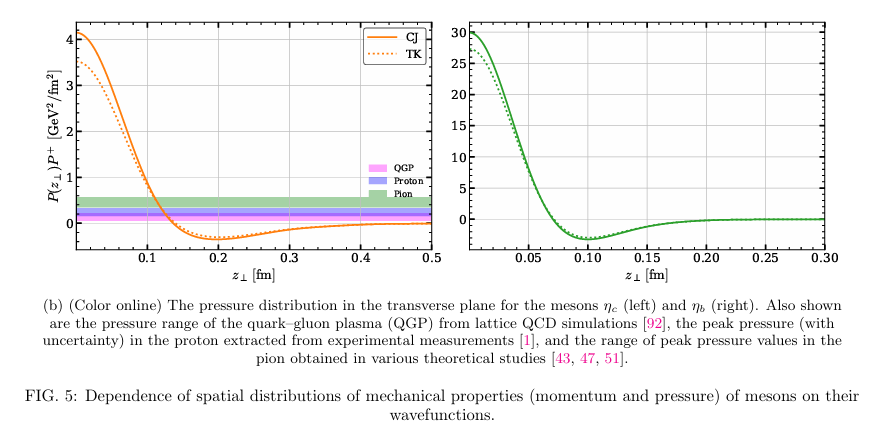
Figure 1: The pressure distribution in the transverse plane for the mesons $\eta_c$ (left) and $\eta_b$ (right). Also shown are the pressure range of the quark-gluon plasma (QGP) from lattice QCD simulations, the peak pressure in the proton, and the range of peak pressure values in the pion.